Archive report: Disasters in the Arquivo Histórico de Moçambique, Maputo
By Matthew Hannaford, 5 August 2026
In the first of our 'archive report' blog posts, I wanted to write about a recent trip to the Arquivo Histórico de Moçambique (AHM), Maputo. Research fellow Pascoal Gota and I have just concluded an intensive few weeks sifting through and transcribing diverse materials relating to climate-related disasters. Overall, the visit probably exceeded our expectations, at least in respect of the material we encountered, if not at all times in ease of access. The visit also neatly tied into the PANAF Congress, held at the Universidade Eduardo Mondlane, where one of the archive’s branches is located.
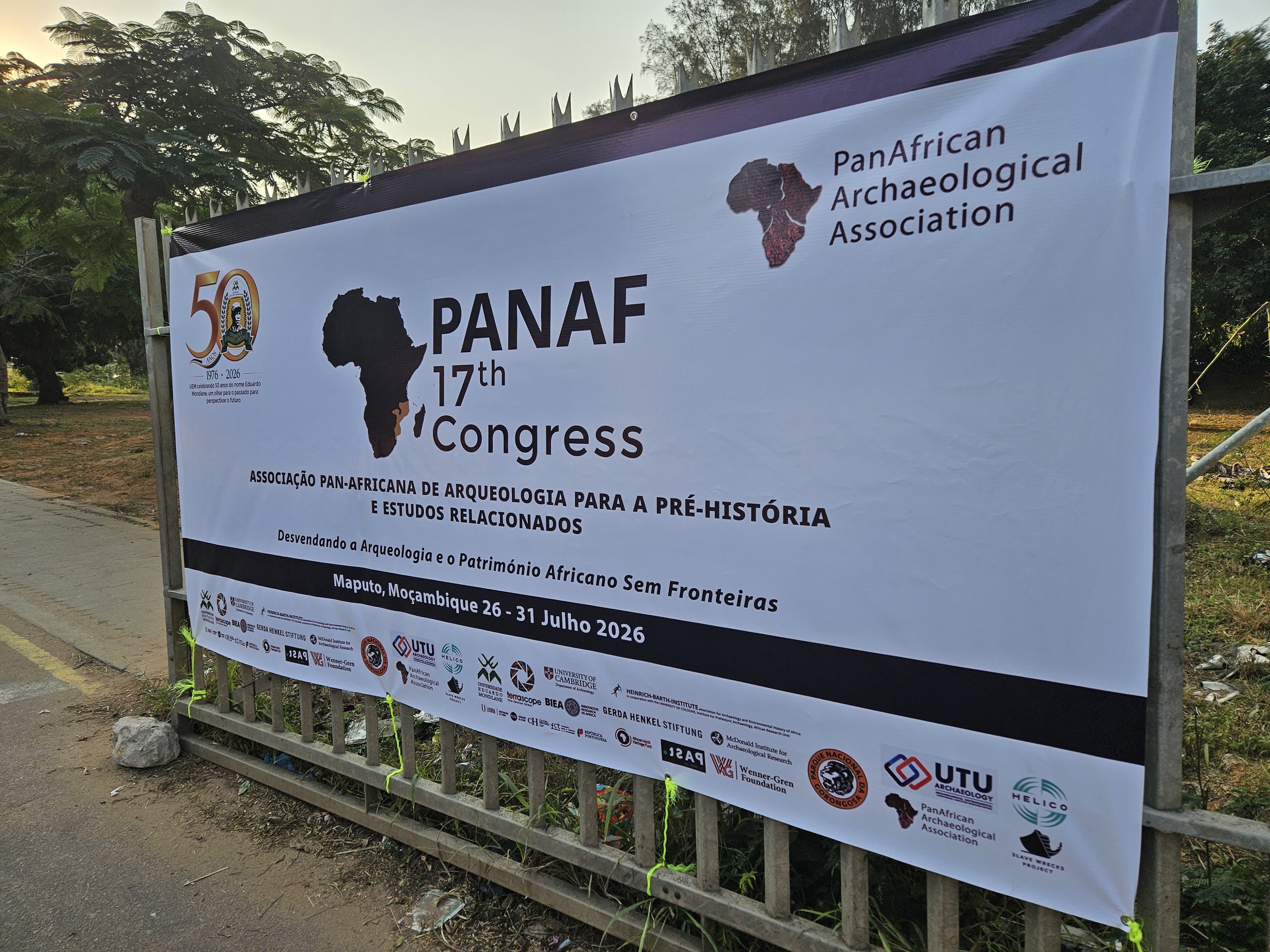
PANAF 17th Congress, Universidade Eduardo Mondlane, 2026
This isn't the first time I have visited the archive, but it is the first time I have worked in any depth with twentieth century materials held in Mozambique. Fortunately, the twentieth century presents a less daunting task owing to the existence of inventories, many of which are paper-only, though a small number are digitised. Even more fortunate for those working on disasters is that the cataloguing of many of the fonds bundled and labelled materials relating to 'Calamidades, Sinistros, Cataclismos and Salvação Publica' (Calamities, Disasters, Cataclysms and Public Salvation). This not only gave us an obvious place to start, but provided enough rich material to occupy much of our time.
So what did these materials include? Our starting point was the Direcção dos Serviços dos Negócios Indígenas (Native Affairs Department) and Governo Geral fonds, which compile documents – mostly letters, reports, telegrams, and occasional photographs of storm damage – across the breadth of the country, albeit with a bias towards southern Mozambique. The first box I consulted contained 38 files, ranging from a report of people whose homes had been flattened and livestock lost in the December 1946 cyclone at Ibo, to the forms of famine relief that dominated the early-twentieth century. These are extremely rich sources for researching different aspects of disasters and, photography not being permitted, took the best part of five days to work through. The equivalent files in the Governo Geral boxes were also useful, although focused to a greater extent on the impact of hazards on settlers – a good example being the detail on the submerged Volkswagen’s of three Sisal planters in Cabo Delgado during the December 1965 cyclone.
The cataloguing of Calamidades also carries through to the fonds of the former colonial districts, circumscriptions and administrative posts. With some notable exceptions, many of these were thinner in detail – some consisting of a few telegrams, while several others more or less entirely focused on donations pledged for the victims of disasters in Portugal, most notably the 1941 Iberia cyclone. Records for some districts, including Inhambane, were not currently publicly accessible.
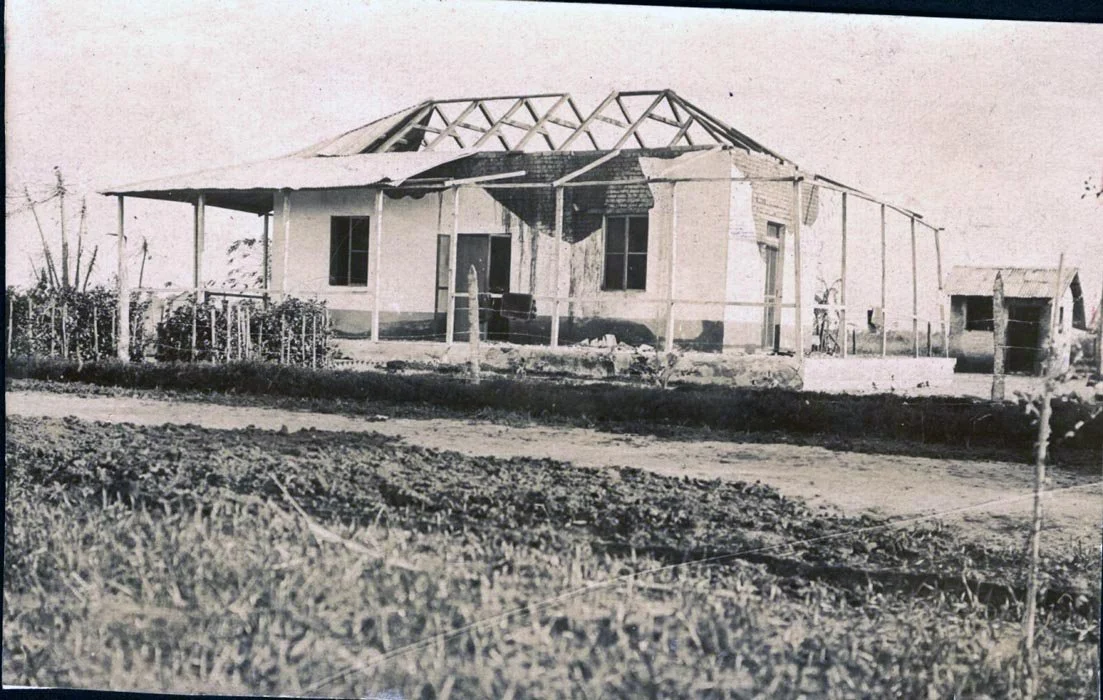
‘A casa do chefe depois do ciclone’ (The chief’s house after the cyclone [of 1922]), PT/TT/CMZ-AF-GT/E/12/1/28, Companhia de Moçambique archive, Arquivo Nacional Torre do Tombo, Lisbon.
What of the other materials we consulted? Documents on meteorology, though reasonably abundant, left much to be desired. At the district level, these were largely short documents consisting of observations of particular phenomena over a short period. Some of the meteorology files in the Governo Geral fond offered more promise, in particular a small bundle of letters between the Mozambique meteorological department and other meteorological services in southern Africa and the southwest Indian Ocean. These letters often contained requests for more routine data sharing on particular atmospheric processes that did transcended colonial borders, such as the phenomenon of cold air masses “invading” colonial Zimbabwe from Mozambique, which brought bad weather during the dry season.
The Diários de Serviços – essentially daily diaries kept by regional and local administrators – are another incredibly detailed source. Time did not permit us to read many of these, but future work will allow us to perform a more targeted reading of particular diaries to examine the day-to-day unfolding of disasters. The extracts we examined for Quelimane and Memba were very useful in this respect. Boxes on sementes (seeds) also offer promise for building more detailed understandings of drought and interventions in food systems, for as elsewhere in colonial Africa seed distribution was a key pillar of response to drought and hunger.
The Mozambique Company materials (part of which are also available in Lisbon and York) were more difficult to access, largely owing to their storage conditions and organisation. However, the few boxes that we were able consult provided considerable detail on storms and floods around Beira during the first three decades of the twentieth century. Further documents here related to land reclamation and dredging in Beira as well as micro-scale conflicts over water.
As ever, chance finds gave us sharpened insight into what we might look for elsewhere, especially in Lisbon. The Relatório do Departamento Maritimo for 1916-17, found in a box containing diaries for Maxixe, was one such case. Contained within are reports of the port and naval delegation captains as well as a table of naufrágios (shipwrecks), which details the date, place and, crucially, cause of the wreck, including “ciclone" and “vento”. The 1916-17 report stated that two and nine vessels were lost due to cyclones in Chinde and Quelimane, respectively.
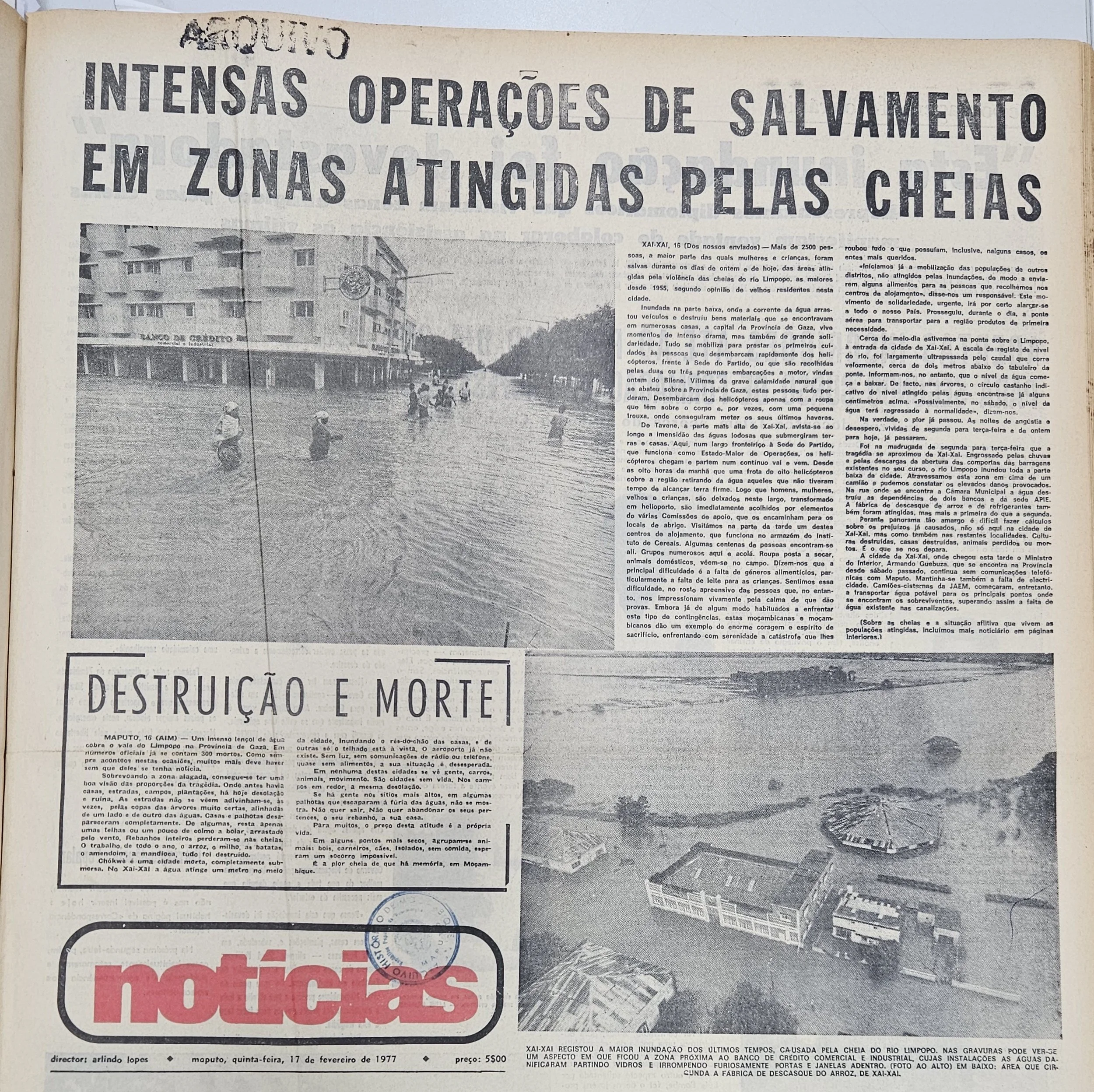
The front page of the Notícias newspaper, 17 February 1977. The headline describes the ongoing intense rescue operations in flood-stricken areas.
Lastly, we also made time to consult inventories for the oral history collections (held at the downtown branch), the Comissão Nacional de Aldeias Comunais (National Commission for Communal Villages) for the late-1970s and early-1980s, and a short run of the Notícias newspaper for the 1977 and 2000 floods – the latter of which came in the wake of cyclone Eline. The oral history collections are extensive, however we only found a couple of transcripts that were catalogued as containing information on famines or disasters. This is not to say that the other items in the inventories say nothing about these phenomena, though. The Notícias also presented a rich source for disaster impacts, responses and recovery through the lens of the socialist independence government during its early years. The floods stayed in the news for months, and certainly more remains to be written about these events in their historical context.
All in all, this was an incredibly worthwhile few weeks at the AHM. It is challenging to plan how long is needed at an archive where only a fraction of the inventories can be viewed before visiting. That said, I think we had just enough time to achieve our objectives. We give thanks to the archivists who offered advice in helping us navigate the less familiar waters of the twentieth century.
